
Google's New Research: Two Phone Photos Can Now Predict Your Diabetes Risk Almost as Accurately as a Hospital Scan
No fasting, no blood draw — a Google research prototype estimates metabolic risk from two ordinary smartphone photos, and it's getting surprisingly close to hospital-grade accuracy.
Imagine skipping the overnight fast and the blood draw entirely, and instead just taking two photos of yourself on your phone. Within seconds, an algorithm produces a metabolic risk score that comes close to matching what a hospital-grade body scan would tell you.
That's not a far-off concept — it's an early result from a new Google research project, and it hints at something bigger than a neat demo: a glimpse of how low-cost, "invisible" health screening could eventually reach millions of people who currently get no screening at all.
A Dangerous Warning Sign That's Easy to Miss
Long before a type 2 diabetes diagnosis, the body is frequently already dealing with insulin resistance — cells becoming less responsive to insulin, forcing the pancreas to work harder, quietly damaging blood vessels, the liver, and the body's energy systems years ahead of a routine blood sugar test picking anything up.
Properly measuring insulin resistance typically calls for a clinical test known as HOMA-IR, which requires a fasting blood draw most people never get unless a doctor orders one specifically. The tools that estimate where body fat is distributed — a key factor tied to insulin resistance — are even harder to access. The gold standard, a DXA scan, is accurate but costly and involves a small radiation dose, making it impractical as something to do casually or even annually.
Wrist-worn fitness trackers can estimate overall body fat percentage, but that number is fairly blunt. It says nothing about where the fat is actually stored, and location turns out to matter a great deal — two people with the same body fat percentage can carry very different metabolic risk depending on whether that fat sits around the belly and organs or around the hips and thighs.
Turning a Smartphone Photo Into a Body Scan
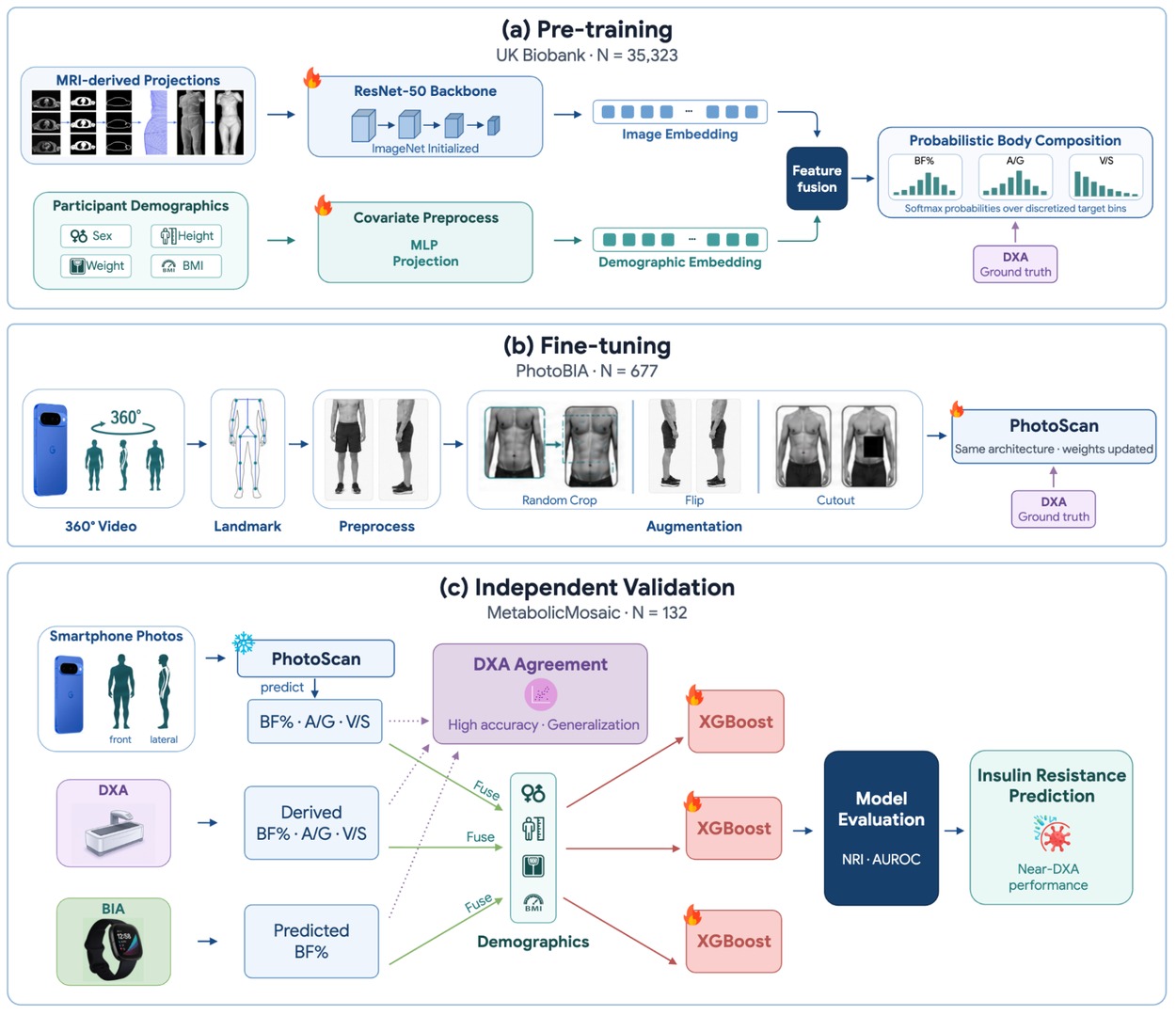
Researchers built a deep learning system, nicknamed PhotoScan, that estimates detailed body composition metrics from a couple of standard 2D photos, with no special equipment involved. Rather than just estimating overall body fat, it targets two more specific, clinically meaningful measurements: how fat is distributed between the torso and the hips and thighs (an "apple" versus "pear" shape, a strong predictor of metabolic risk on its own), and how much fat surrounds the internal organs versus sitting just under the skin — the visceral fat that carries far more metabolic risk than fat you can pinch.
To build the system, the team first trained the model on tens of thousands of body scans from a large biobank dataset, then fine-tuned it using real smartphone photos matched against DXA scan results from hundreds of volunteers, and finally tested it on a separate group of people who'd also had blood work, fitness tracker data, and detailed body scans collected over several months.
Nearly as Accurate as an Expensive Hospital Scan
Using only baseline information — age, sex, and BMI — to predict insulin resistance produced decent but unremarkable accuracy. Adding a smartwatch-style body fat estimate barely improved things at all.
Adding the smartphone-photo-based measurements, however, pushed predictive accuracy up substantially, landing just below what an actual clinical DXA scan would provide. In practical terms, two ordinary photos got researchers most of the way to hospital-grade insight, while a wrist-worn sensor essentially added nothing.
Knowing where fat sits on the body mattered far more for predicting metabolic risk than simply knowing an overall body fat percentage.
Why This Actually Matters for You
This is still a research prototype, not something you can download today, and it hasn't yet gone through the large-scale, diverse validation that would be needed before doctors could rely on it. Even so, the implications are worth paying attention to.
Screening for metabolic risk could become far cheaper and more accessible — a large share of people at risk for prediabetes or metabolic syndrome are never screened simply because the good tests are inconvenient or expensive, and a phone-camera-based estimate could shift that equation. This research also adds to a growing pile of evidence that BMI alone is a poor stand-in for actual metabolic risk, since two people with the same BMI can have very different fat distribution and very different risk profiles. And it's a useful reminder that a fitness tracker's body composition estimate isn't the full picture — convenience and accuracy aren't the same thing, and where fat sits may matter more than how much of it there is.
The bigger trend here is a shift toward passive, low-friction health monitoring: tools that quietly work in the background of a phone people already own, rather than requiring a special appointment or piece of equipment. Whether or not PhotoScan itself ever becomes a real app, it's a strong signal of where consumer health tech is heading next.